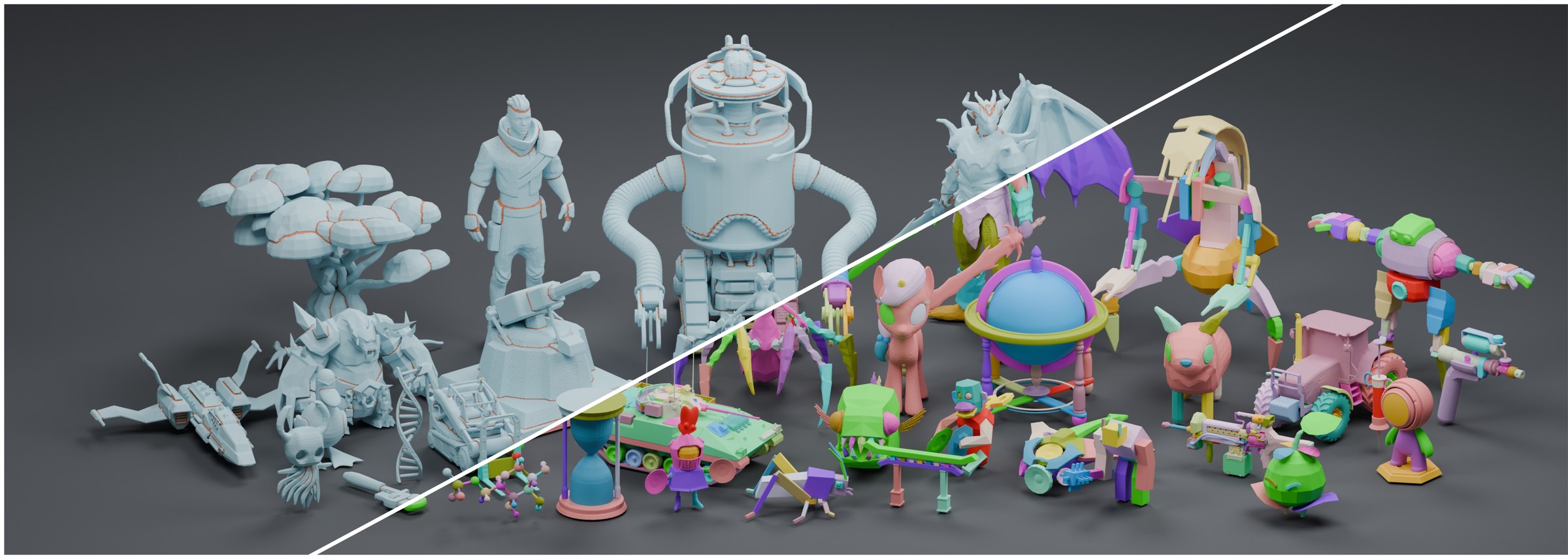
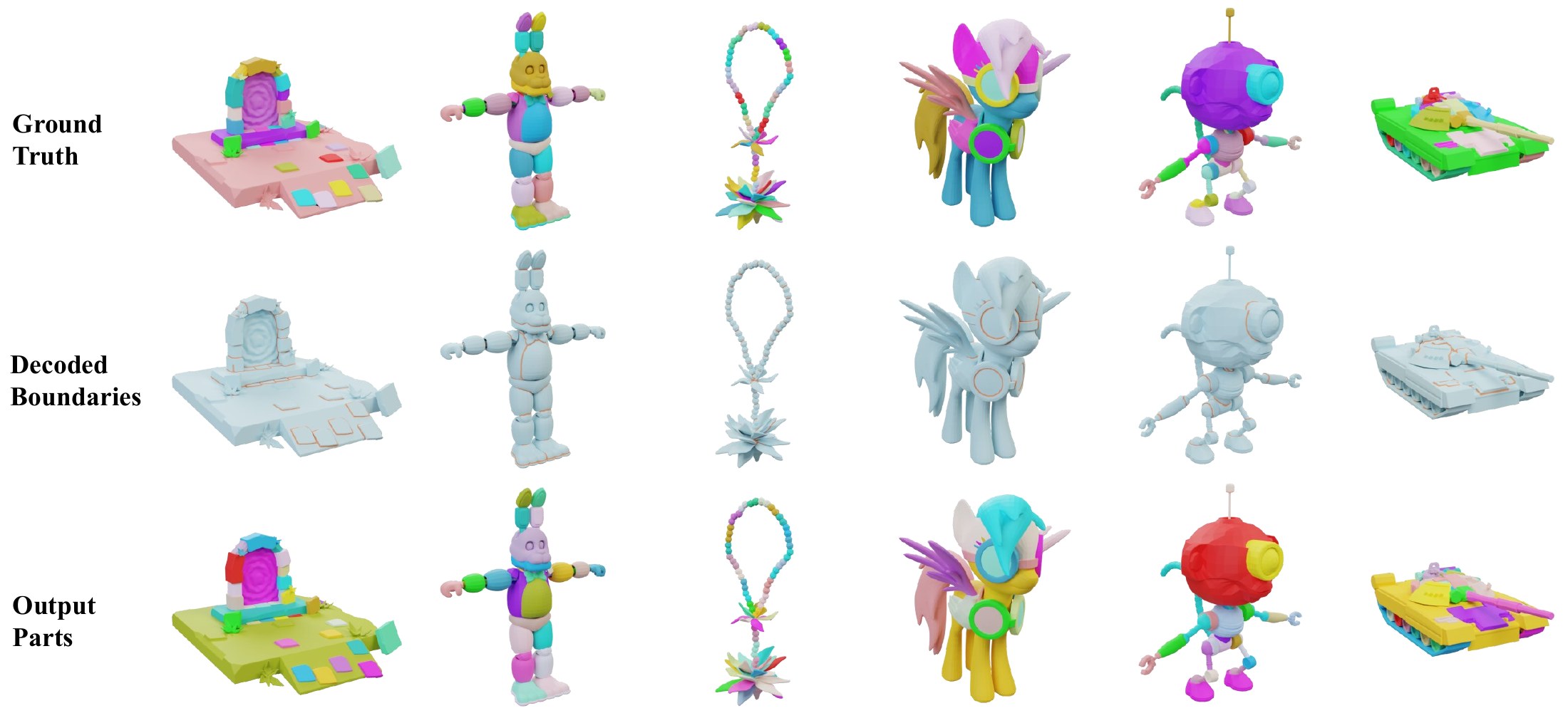
Our method natively integrates part decomposition into the 3D generation pipeline, jointly producing high-fidelity geometry and part-separation cues that explicitly encode the object's decomposable structure and ultimately yield coherent part assets.
Abstract
Recent 3D generative models produce high-quality assets but typically treat objects as monolithic shapes. Existing part-aware approaches address this limitation through external segmentation, predefined layouts, or additional planning, leaving shape generation and part discovery largely decoupled. In this work, we propose a native part-aware 3D generation framework that models inter-part separation instead of explicit part assignments. Our key observation is that recovering part structure does not require explicit part assignments over the entire shape; it is sufficient to identify the interfaces where contacting parts should be separated. We therefore cast part decomposition as a local boundary prediction task, replacing open-ended part assignments with simple binary separation cues.
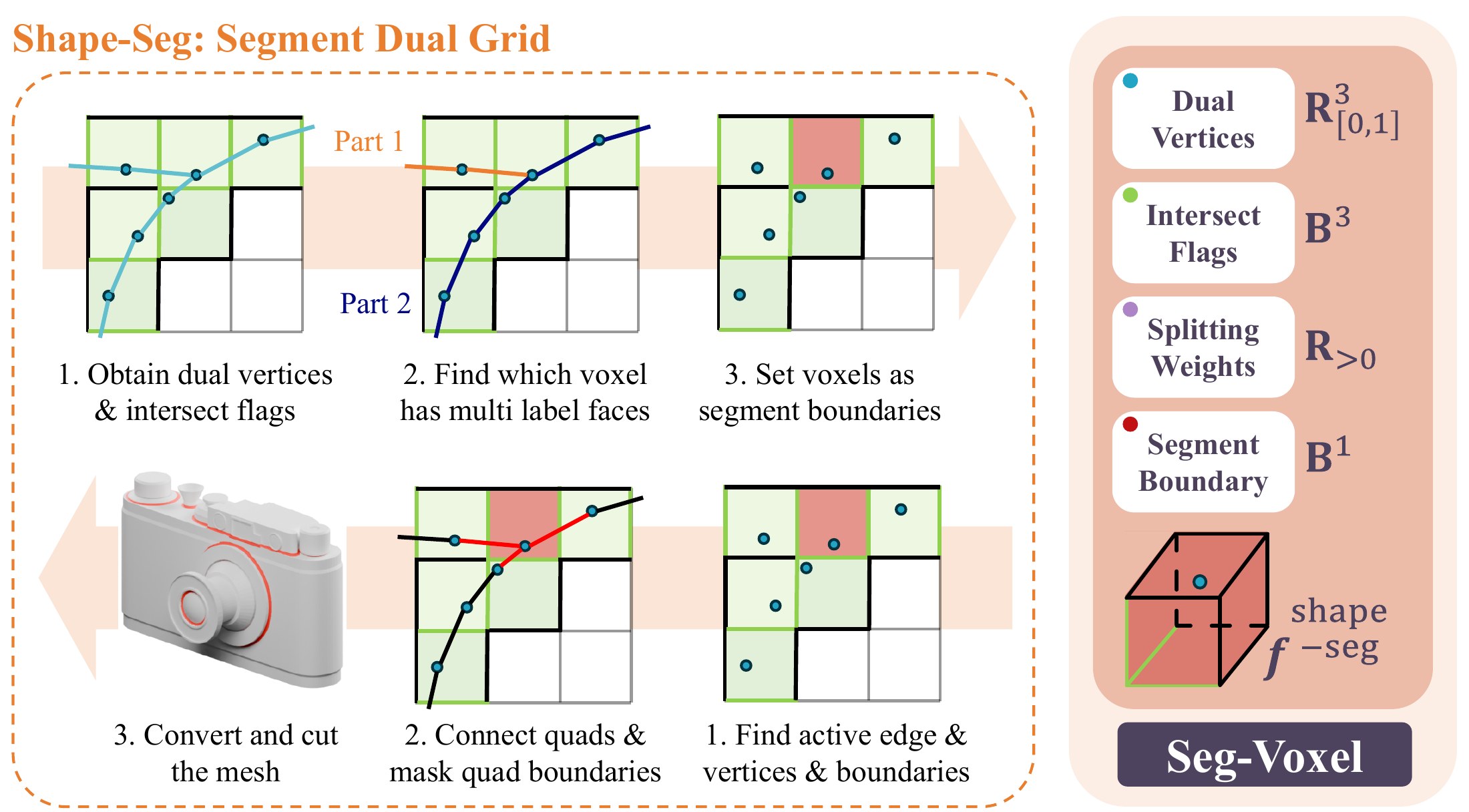
To support this formulation, we introduce Seg-Voxel, a sparse voxel representation built upon the voxel design of TRELLIS.2 that jointly encodes geometry and inter-part boundaries. We further develop a native 3D generative pipeline that synthesizes Seg-Voxel to jointly generate object geometry and the separation structure required to partition it into individual components. The predicted boundaries are refined to ensure reliable geometric separation, then reassigned to adjacent components to recover coherent part assets.
Experiments demonstrate that our method outperforms existing part-aware approaches in geometric quality, decomposition accuracy, and efficiency, enabling high-quality native part-aware generation without external segmentation or complex post-generation planning.
Method
Seg-Voxel representation
Seg-Voxel and the instant bidirectional conversion between a part-structured 3D asset and Seg-Voxel. A voxel is marked as a segment boundary when its surface intersections carry more than one part label; removing boundary faces disconnects adjacent parts.
Overall framework
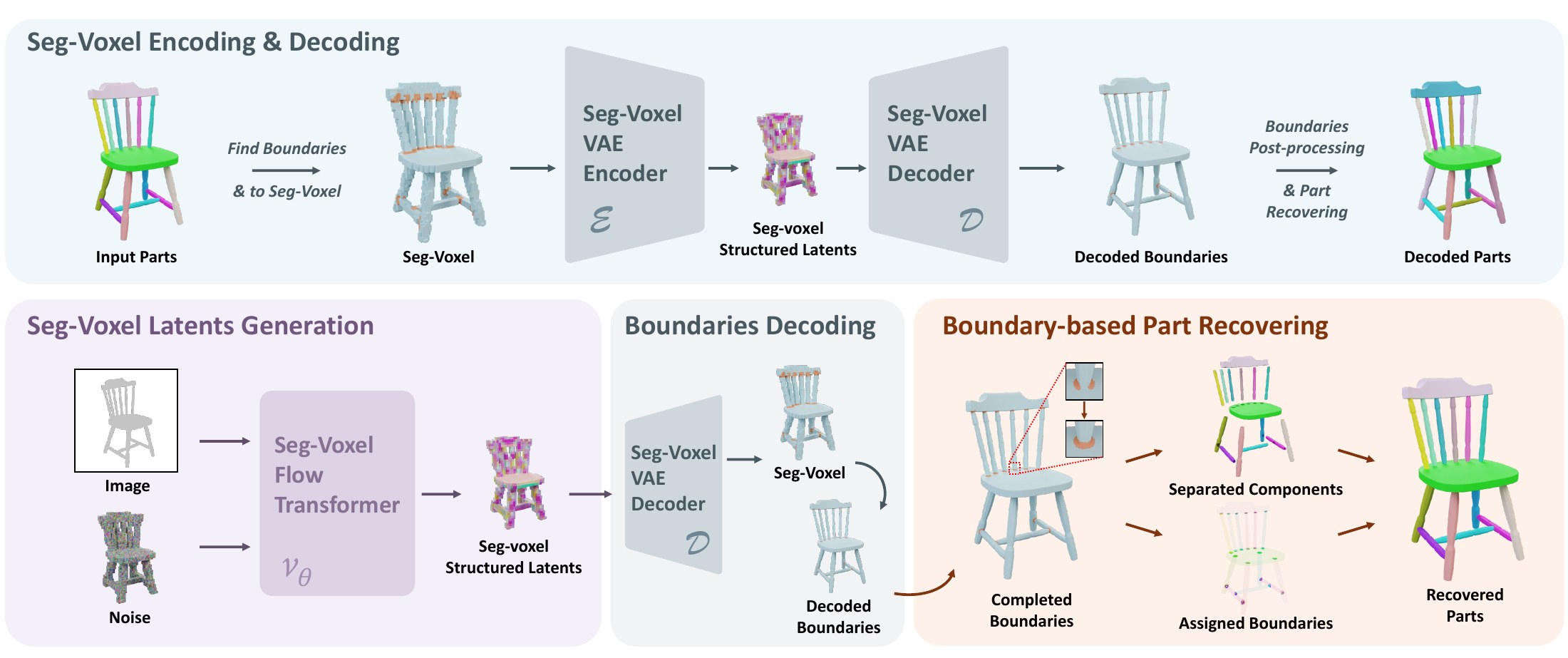
Part meshes are converted into Seg-Voxels and encoded by a Seg-Voxel VAE. A flow-based generator synthesizes Seg-Voxel latents conditioned on the input image, which are decoded into geometry together with initial separation boundaries. The boundaries are then completed, used to split the geometry into disconnected components, and reassigned to neighbouring components to recover the final parts.
Boundary-based part recovering
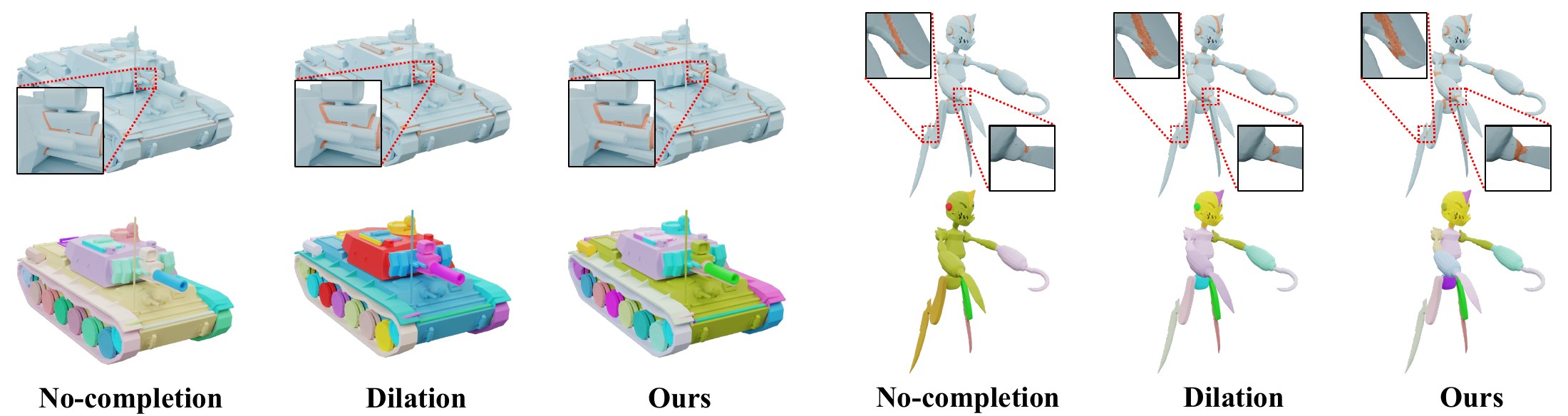
(1) Identify incomplete boundaries and (2) build cross-boundary pairs; (3) compute the path-traffic of each face as the number of shortest residual paths passing through it; (4) starting from the highest-traffic face, expand the search radius to find open boundary ends and connect them; (5) removing the completed boundary yields separate components, whose labels then (6) propagate synchronously to assign the boundary surface.
Results
Part-level 3D generation
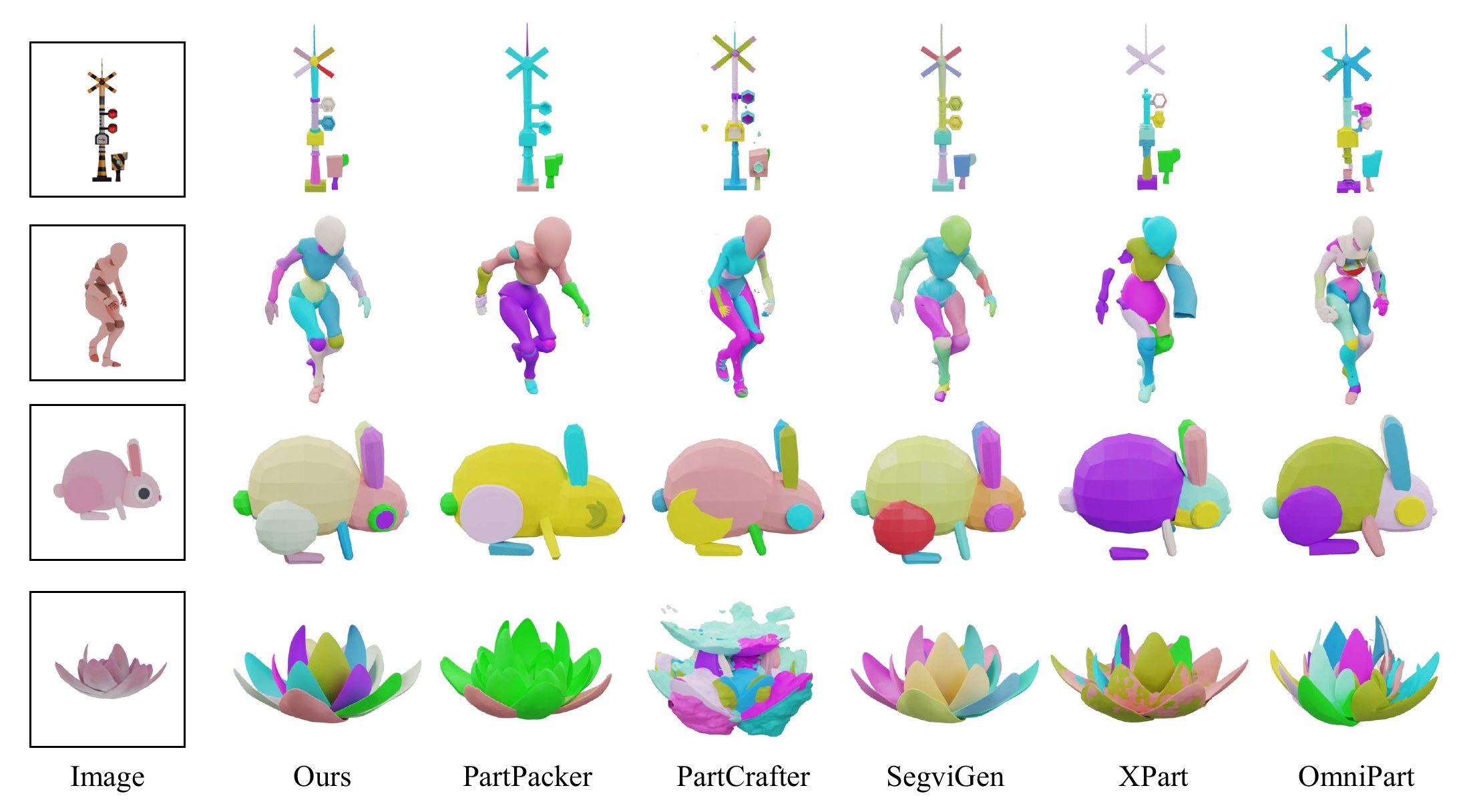
Qualitative comparison of image-conditioned part-level 3D generation.
Method
CD ↓
F10.1 ↑
mCD ↓
mF10.1 ↑
Time (s) ↓
PartPacker
0.506
94.74
5.869
71.14
23.76
PartCrafter
0.802
90.21
7.772
63.52
104.99
OmniPart
0.432
95.74
1.599
85.46
38.61
XPart
0.407
95.74
4.441
69.17
442.89
SegviGen
0.203
98.13
1.796
88.35
157.75
Seg-Voxel (Ours)
0.203
98.14
1.242
91.03
20.68
Evaluated on 300 held-out objects from HY3D-Bench Part. CD / F1 measure the merged whole object; mCD / mF1 measure individual parts with best-match evaluation.
Seg-Voxel VAE reconstruction
Reconstruction results of our Seg-Voxel VAE across increasing levels of part complexity.
Method
CD ↓
F10.01 ↑
F10.005 ↑
mCD ↓
mF10.01 ↑
mF10.005 ↑
TRELLIS.2 – 512
0.0056
95.14
65.68
–
–
–
TRELLIS.2 – 1024
0.0055
95.17
65.84
–
–
–
Seg-Voxel – 512 (Ours)
0.0056
95.14
65.73
0.473
84.24
75.35
Seg-Voxel – 1024 (Ours)
0.0055
95.17
65.87
0.456
86.73
79.12
All values ×102. Trained only at resolution 512, Seg-Voxel generalizes directly to 1024 at inference.
Ablation of boundary post-processing
Path-traffic-guided completion closes larger gaps that remain open after fixed-iteration dilation, separating parts that would otherwise stay connected.
Completion
mCD ↓
mF10.1 ↑
No completion
1.973
87.62
Dilation
1.328
90.55
Ours
1.242
91.03
Assignment
mCD ↓
mF10.1 ↑
N-Copy
2.281
85.27
N-Max
1.311
89.78
Ours
1.242
91.03
More results
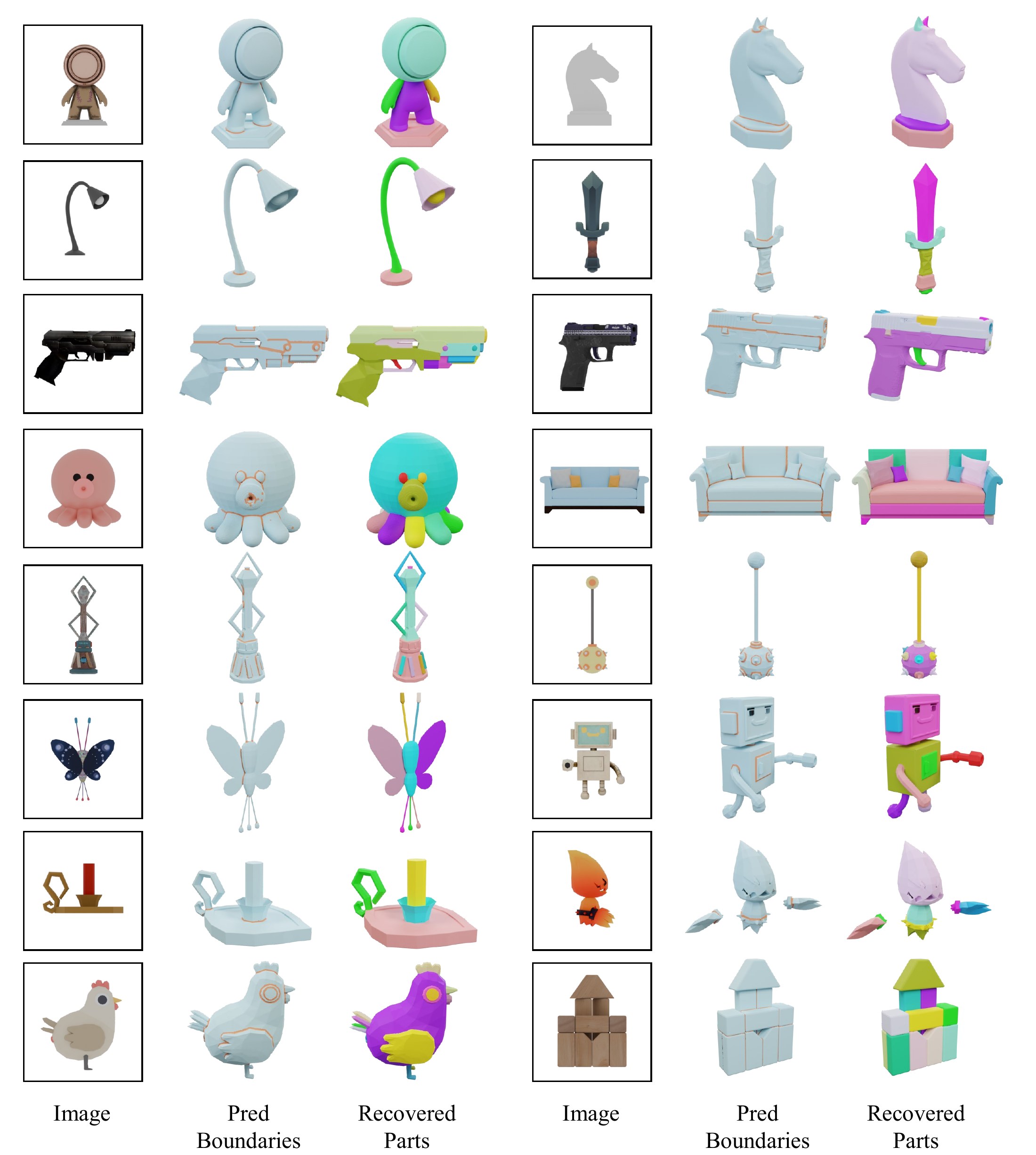
Additional qualitative results. Our method generates coherent parts that assemble into high-fidelity complete objects.